
How Much Should You Really Bid on a Storage Unit?
Learn a simple storage unit bidding formula that helps estimate resale value, subtract fees and hidden costs, set a target profit, and avoid overpaying at auction.
By Jay from LockerLedger
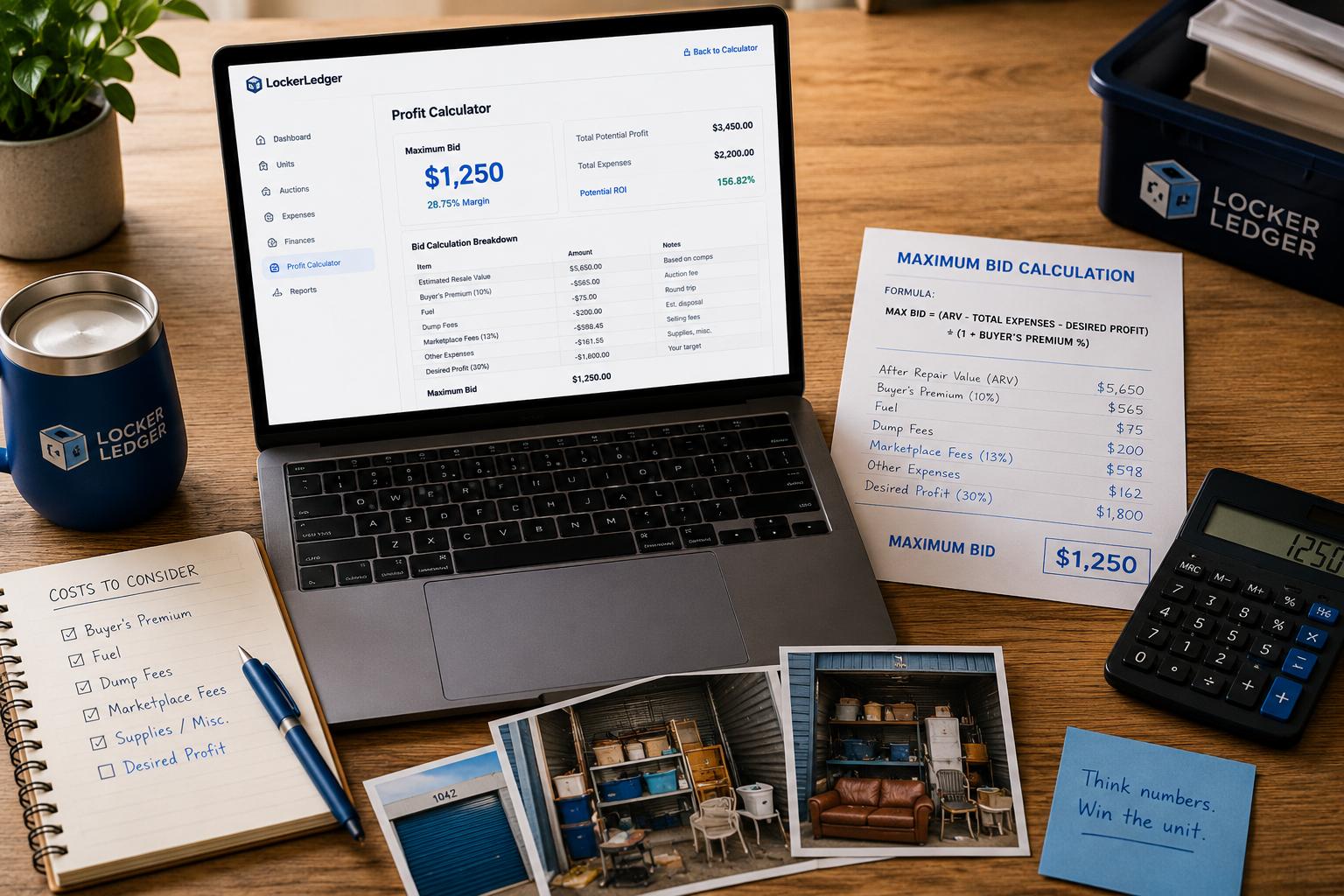
One of the biggest mistakes I made when I first started buying storage units was deciding my maximum bid based on excitement instead of math.
I would look at the auction photos, spot a solid wood dresser, a name-brand toolbox, or maybe a few clean unopened totes, and my mind would immediately start filling in the blanks. Before I knew it, I had convinced myself the locker had to be worth two or three thousand dollars.
Sometimes I was right. Plenty of times I was not.
After a few expensive lessons, I realized something that completely changed the way I buy storage units.
Professional buyers do not only ask, “How much is this unit worth?” They ask, “What is the highest number I can bid and still make money?”
That sounds simple, but it is a completely different way of thinking. The people who consistently make money in this business are not always finding better lockers. They are usually better at protecting their profit.
Once I started treating every auction like a business decision instead of a treasure hunt, everything changed. This is the bidding formula I wish someone had shown me earlier.
Quick answer
A safe storage unit bid starts with conservative resale value, then subtracts marketplace fees, buyer premiums, cleanup costs, fuel, dump fees, and the profit you want to keep. The number left over is your maximum bid.
Step 1: Estimate the resale value, but do not daydream
This is where most beginners get themselves into trouble.
It is incredibly easy to look at auction photos and start pricing everything at its absolute best-case value. You see a bicycle and think it is worth $300 because that is what one sold for on eBay. What you do not see is that the tires are dry-rotted, the chain is rusted solid, and it needs hours of cleaning before anyone will even look at it.
Now it is probably a $75 Facebook Marketplace sale.
When I estimate a unit, I assume the visible items are worth less than I hope. If I am wrong, great. If I am right, I protected my money.
- Never assign value to mystery boxes.
- Never assume expensive items work.
- Price for a reasonably quick sale, not the highest possible sale.
- Treat hidden items as worth $0 until proven otherwise.
If the sealed boxes or hidden items turn out to be great, that is your bonus. I do not want my entire profit plan depending on something I could not even see from the auction photos.
Step 2: Remember that you do not keep every dollar you sell
This one catches a lot of new buyers.
You estimate that everything in the unit will sell for $2,500. Great. But you do not actually get to keep $2,500.
Marketplace fees, payment processing, shipping, boxes, packing supplies, and fuel to meet buyers all chip away at your profit.
If you are selling on eBay or Mercari, it is not unusual to lose a meaningful percentage before the money reaches your bank account. If you are selling locally, you may save on platform fees, but you usually spend more time driving, messaging buyers, waiting on no-shows, and moving items around.
There is no perfect platform. The key is knowing where the item will probably sell before you bid and subtracting those costs ahead of time.
Step 3: Subtract the hidden costs before they surprise you
This is where amateur buyers slowly bleed money.
The winning bid is not what the locker costs. It is just where the spending starts.
- Buyer premium
- Sales tax
- Fuel and transportation
- Dump fees
- Cleaning supplies
- Packing materials
- Small repairs
- Storage or truck rental costs
- Your own time
Those little expenses do not feel like much individually. Together, they can wipe out hundreds of dollars from a unit you thought was a home run.
Related article: 7 costs that quietly destroy profit
I broke down the hidden storage unit costs in more detail in the previous article. It covers buyer premiums, fuel, dump fees, supplies, labor, marketplace fees, refunds, and unsold inventory.
Read the hidden-cost breakdownStep 4: Decide what your time is worth
This is probably the biggest mindset shift I ever made.
Most people calculate profit like this: Revenue minus costs equals profit.
That sounds logical, but the problem is that your profit becomes whatever is left over. You are letting the auction decide what your time is worth.
I flipped the equation around.
Revenue minus desired profit minus costs equals maximum bid.
That one change completely changed the way I buy lockers. Before I even place a bid, I already know how much I expect to earn. If I want to make $600 on a locker, then that $600 comes off first.
If the bidding climbs beyond my number, I stop. No “just one more bid.” No chasing someone else. No auction adrenaline. I move on to the next locker.
It turns out saying no is one of the most profitable skills you can develop.
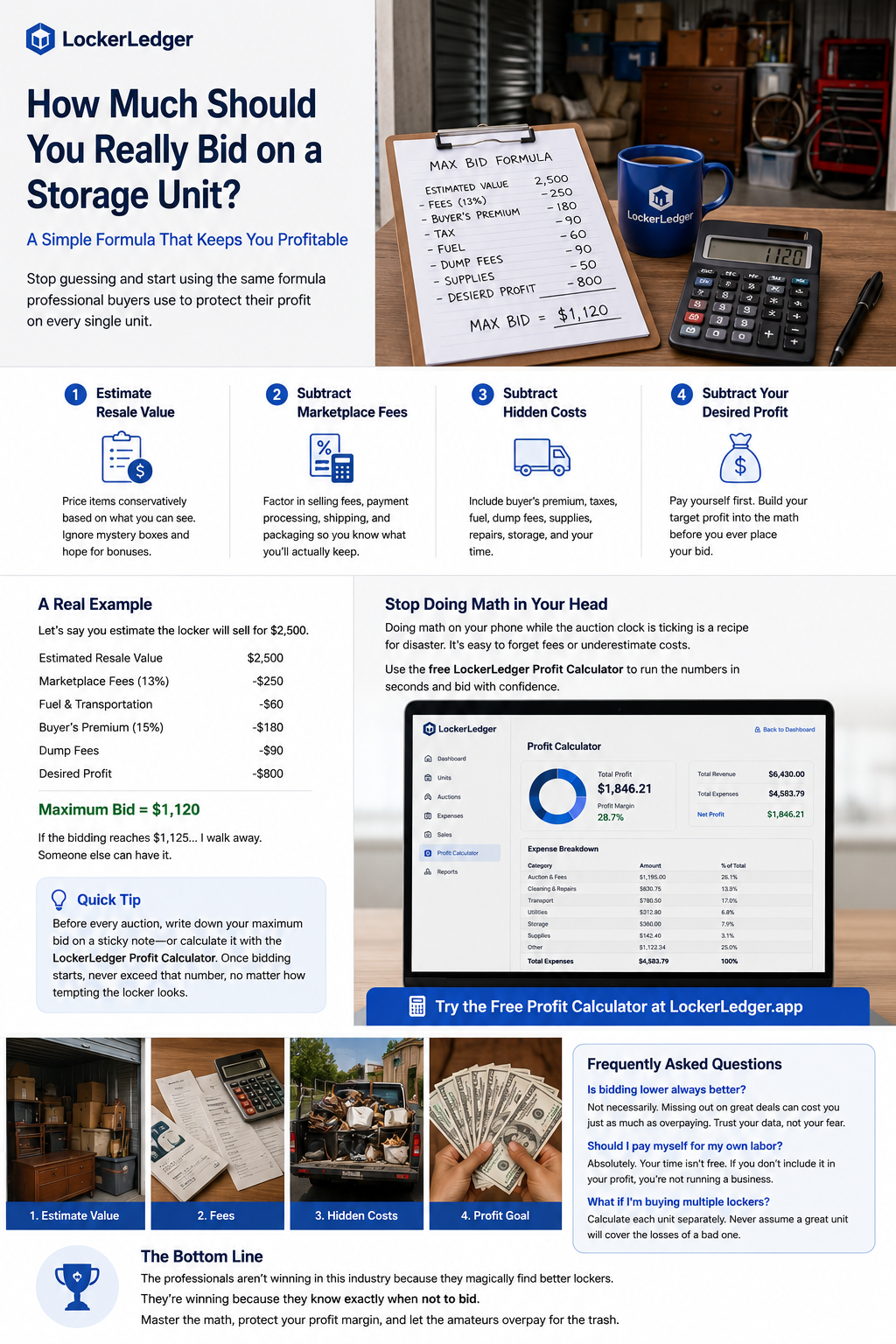
A real example
Let’s say I estimate that a locker will sell for $2,500. I am not using dream prices. I am using conservative numbers based on what I can actually see and what I believe I can move within a reasonable amount of time.
| Line item | Amount |
|---|---|
| Estimated resale value | $2,500 |
| Marketplace fees | -$250 |
| Fuel and transportation | -$60 |
| Buyer premium | -$180 |
| Dump fees | -$90 |
| Desired profit | -$800 |
| Maximum bid | $1,120 |
That means my maximum bid is $1,120.
If the bidding reaches $1,125, I am out. Someone else can have it.
That does not mean the unit is bad. It just means it is no longer a good deal for my numbers. I have learned that missing a locker hurts a lot less than owning an overpriced one.
Stop trying to do this math in your head
I will admit it. I have stood there trying to do this math on my phone while an auction timer was ticking down.
It is stressful, and it is incredibly easy to forget something. Maybe you leave out the buyer premium. Maybe you forget dump fees. Maybe you underestimate marketplace fees. Maybe you forget that you still have to drive back to the facility tomorrow.
Those little mistakes add up fast.
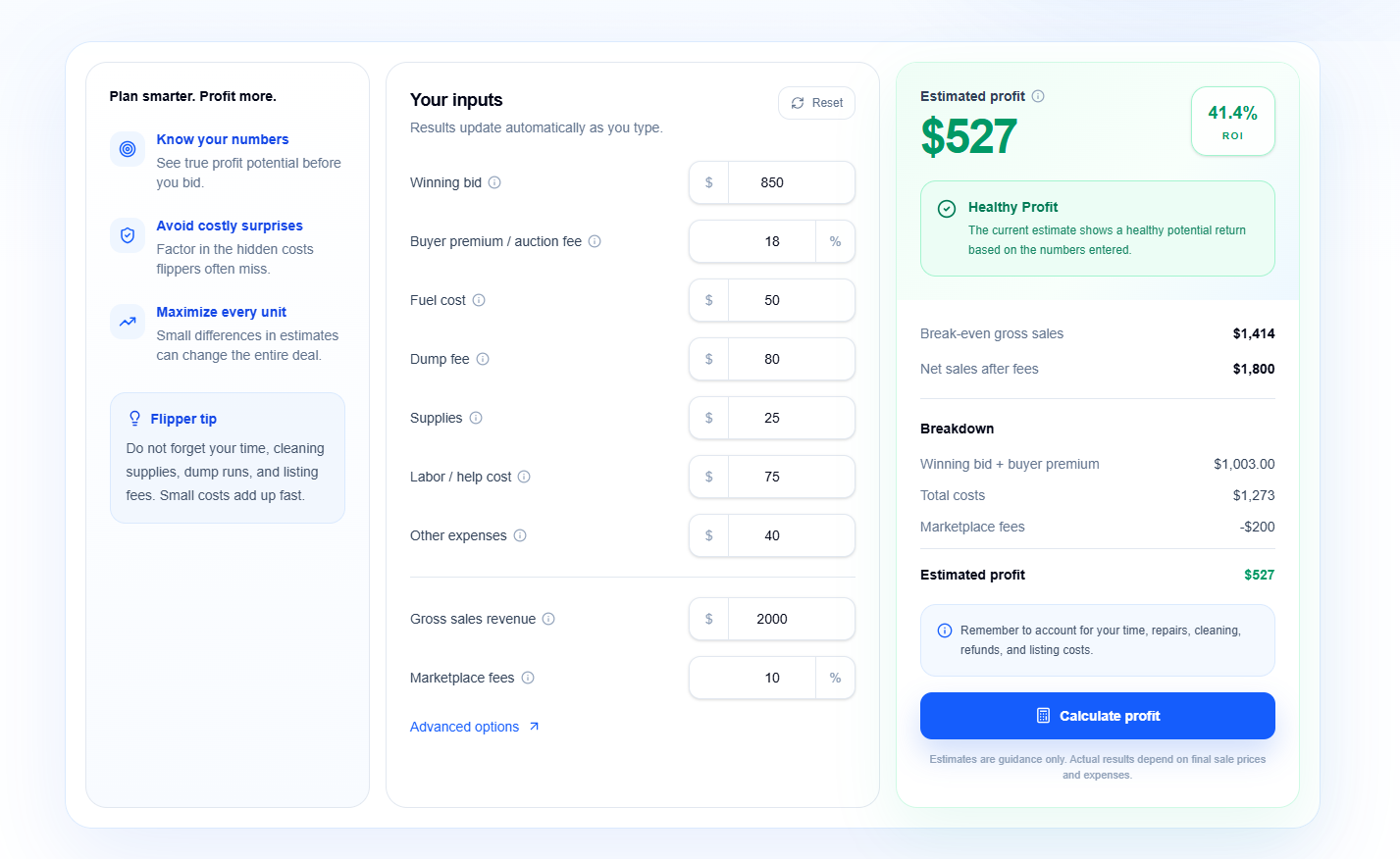
That is one of the reasons I built the free LockerLedger Storage Unit Profit Calculator. I wanted a faster way to enter the bid, estimated costs, expected sales, and target profit without doing mental math under pressure.
Run the numbers before you bid
Use the free Storage Unit Profit Calculator to test your bid, buyer premium, fuel, dump fees, supplies, labor, expected sales, marketplace fees, and estimated profit before the auction clock runs out.
Open the free calculatorQuick tip
Before every auction, write down your maximum bid on a sticky note or calculate it with the LockerLedger Profit Calculator. Once bidding starts, never exceed that number, no matter how tempting the locker looks.
Frequently asked questions
Is bidding lower always better?
Not necessarily. Being too scared to bid can cost you just as much as overpaying. If the numbers say a locker is profitable up to $1,500, stopping at $600 because you are nervous might mean watching someone else make the money you could have earned.
The goal is not to always bid low. The goal is to bid with discipline.
Should I pay myself for my own labor?
Absolutely. Your time is not free.
If it takes ten hours to clean, sort, photograph, list, answer messages, and meet buyers, that time has value. If you ignore it, you are not calculating profit accurately.
What if I am buying multiple lockers?
Treat every unit as its own business. Never assume a great locker will make up for a bad one.
Every locker should make financial sense on its own. If it does not, I would rather pass and keep my cash available for a better opportunity.
LockerLedger takeaway
One thing I have learned over the years is this: the professionals are not making money because they always find better lockers. They are making money because they know exactly when not to bid.
The auction is exciting for a few minutes. The profit or the loss sticks with you much longer.
Protect your numbers. Protect your profit. And do not be afraid to let someone else overpay.
I have won plenty of storage units over the years, but one of the best financial decisions I ever made was learning when to walk away.
Early Demo Access
Want to track your next storage unit from bid to profit?
LockerLedger early demos are opening soon for storage auction buyers, resellers, and flippers who want a cleaner way to manage units, inventory, expenses, sales, and profit.
Request Early Demo