
7 Storage Unit Costs That Quietly Destroy Your Profit
Discover seven overlooked storage unit flipping expenses—including buyer premiums, fuel, dump fees, labor, marketplace fees, and unsold inventory—and calculate your real profit.
By Jay from LockerLedger
There is a moment during almost every storage auction when the numbers start looking a little too good.
You spot a decent piece of furniture near the front, a few sealed boxes in the back, maybe some electronics or tools tucked along one wall. Before the auction is even over, you are already doing the math in your head:
Bid $200. Sell everything for $1,000. Walk away with $800.
I have done that math plenty of times.
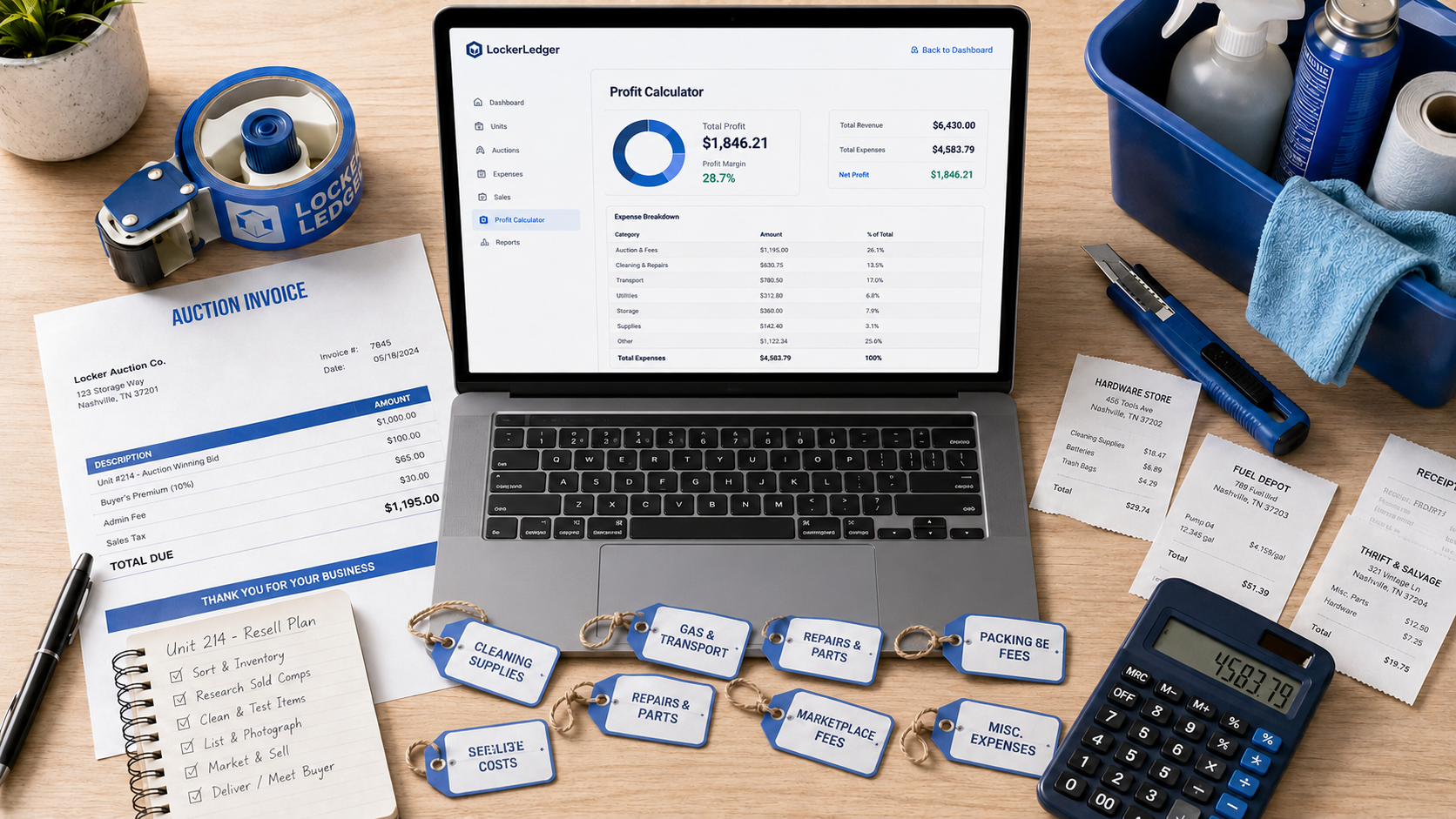
The problem is that the winning bid is only the first number. Once my wife and I started cleaning out units, hauling items, making dump runs, buying supplies, and selling across different marketplaces, I realized just how many small expenses were hiding between the auction and the final profit.
Those costs do not always feel significant in the moment. Fifty dollars in fuel here. A dump fee there. Tape, boxes, cleaning supplies, help moving a heavy dresser.
Individually, they seem manageable. Together, they can completely change whether a unit was actually profitable.
Why the winning bid is only the starting cost
When you win a storage unit, the final auction price is really just the price of admission.
It gets the door open, but it does not cover what happens next.
You still have to travel to the facility, remove everything before the deadline, decide what can be sold, dispose of what cannot, clean the usable items, photograph them, create listings, deal with buyers, and sometimes store inventory for weeks or months.
When I first started, it was easy to compare only two numbers: what I paid for the unit and what I sold the items for.
That makes the profit look great, but it leaves out nearly everything that happened in between. The real number that matters is your total cost, not just your winning bid.
1. Buyer premiums and auction fees
The first surprise can arrive before you even leave the auction website.
Many auction platforms and facilities charge a buyer premium, processing charge, or other fee on top of the winning bid. A unit that closes at $500 may not actually cost you $500. A 15% buyer premium adds another $75 before fuel, labor, or cleanup even begins.
This is why the maximum amount you are willing to bid should already account for the premium. Waiting until after the auction to include it can turn a reasonable purchase into an expensive one.
2. Fuel and repeated pickup trips
I have learned that one quick pickup has a way of becoming several trips.
You may need one trip to inspect and begin sorting, another to haul furniture, another for boxes and smaller items, and another to take trash to the dump. If the facility is not close to home, those miles add up quickly.
Fuel becomes even more noticeable when you are driving a truck, towing a trailer, or leaving the vehicle running while loading and unloading. It is easy to dismiss each trip as part of the job. It is still a business expense.
3. Dump and disposal fees
A storage unit can look valuable from the doorway while hiding a surprising amount of trash behind the sellable items.
Broken furniture, damaged mattresses, old clothing, empty containers, water-damaged boxes, and general household waste all have to go somewhere. Depending on where you live, the landfill or transfer station may charge by weight, vehicle, or load.
A unit with several good items can still produce a truckload of unusable material. If the dump costs are not included, the profit shown on paper will be higher than the money you actually kept.
4. Cleaning supplies and packing materials
Almost nothing comes out of a storage unit ready to photograph and sell.
- Cleaning sprays and disinfecting wipes
- Gloves, trash bags, paper towels, and shop rags
- Boxes, packing tape, and bubble wrap
- Furniture blankets and moving supplies
- Replacement batteries and small repair materials
None of these purchases seem huge by themselves. The problem is how often they happen. A few trips to the hardware store or discount store can quietly add another $50 or $100 to the cost of processing a unit.
5. Marketplace and payment fees
The amount a buyer pays is not always the amount that reaches your pocket.
- Marketplace selling fees
- Payment-processing charges
- Shipping costs
- Promoted listing fees
- Consignment percentages
- Refunds or return costs
A $100 sale does not necessarily create $100 in usable revenue. This matters even more with lower-priced inventory, where small fees repeated across dozens of sales can become one of the unit’s largest expenses.
6. Labor and paid help
Some items simply cannot be moved safely by one person.
A heavy dresser, appliance, sectional sofa, or packed unit may require help. That help might come from a friend, family member, hired worker, or moving service.
Even when no money changes hands, your own time still has value. Sorting, cleaning, photographing, researching, listing, answering messages, meeting buyers, and managing no-shows can consume far more hours than the cleanout itself.
A unit can technically make money and still not be worth the time it demanded.
7. Repairs, refunds, and unsold inventory
Not every item will sell quickly, and some will never sell at all.
You may discover that an electronic item needs a charger, a chair needs hardware, an appliance does not work, or a piece of furniture needs more repair than expected.
Then there is unsold inventory. It is tempting to count the estimated value of everything still sitting in the garage as future profit. I have learned to be careful with that.
An item is not profit just because it might sell someday. Until the buyer pays, it is still inventory taking up space.
A simple real-world example
Imagine winning a unit for $300 and estimating that the contents will eventually sell for $1,000. At first glance, that appears to be a $700 profit.
| Expense category | Amount |
|---|---|
| Winning bid | $300 |
| Buyer premium at 15% | $45 |
| Fuel for two trips | $40 |
| Dump fees | $60 |
| Cleaning and packing materials | $30 |
| Marketplace and payment fees | $120 |
| Total costs | $595 |
Your actual estimated profit is not $700. It is $1,000 in revenue minus $595 in total costs, which leaves $405 in profit.
And that still does not assign a dollar amount to the hours spent cleaning, sorting, listing, and meeting buyers. The unit may still be worthwhile, but it is a very different result from the quick calculation made during the auction.
How to calculate your actual storage unit profit
The basic formula is simple: Profit = Revenue − Total Costs.
The harder part is remembering everything that belongs under total costs.
- Winning bid and buyer premium
- Fuel, dump fees, supplies, and labor
- Repairs, storage costs, and other unit-specific expenses
- Marketplace fees, payment fees, and refunds
ROI helps compare units of different sizes. A unit that makes $500 after costing $500 has a very different return from one that makes $500 after costing $2,000.
Use the free Storage Unit Profit Calculator
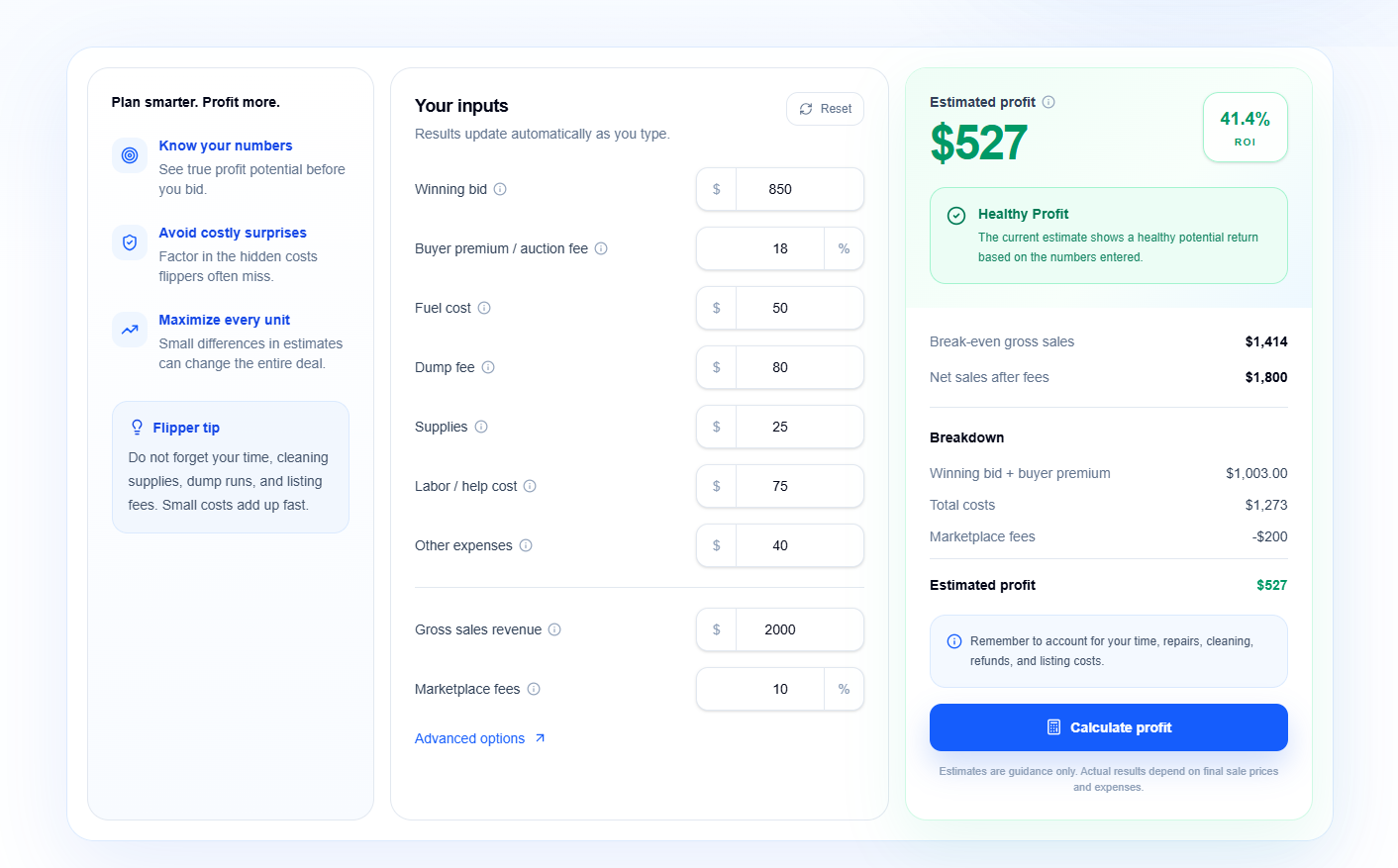
Enter your winning bid, buyer premium, fuel, dump fees, supplies, labor, expected sales, and marketplace fees to see estimated profit, ROI, net sales, and break-even gross sales. No account is required.
Open the free calculatorFinal takeaway: Revenue is not profit
Storage unit flipping can absolutely be profitable, but the money is made in the details.
The exciting part is opening the door and discovering what is inside. The business part is tracking what it actually costs to turn those items into cash.
Revenue is the big number that feels good when an item sells. Profit is what remains after the auction fees, fuel, dump runs, supplies, marketplace charges, labor, repairs, and unsold inventory are accounted for.
The more accurately I track those costs, the less I have to guess whether a unit was worth buying. And that confidence is worth far more than the optimistic math I used to do while staring through a storage-unit doorway.
Early Demo Access
Want to track your next storage unit from bid to profit?
LockerLedger early demos are opening soon for storage auction buyers, resellers, and flippers who want a cleaner way to manage units, inventory, expenses, sales, and profit.
Request Early Demo